Some Thoughts on Plugin Ergonomics
 3 min read
Over the past three years, I have almost stopped buying new plugins.
In fact, the palette of tools I actually use in real projects has only been getting smaller. Even with hundreds of plugins and dozens of bundles available, only a very small number of them make it into constant use.
Thinking about it, I came to the conclusion that the main reason behind my choices is not necessarily the sound, the manufacturer, or even how advanced the algorithms are.
It is ergonomics and usability.
A simple example: the UAD 1176 compressor.
I like how it sounds, but I have almost completely stopped using it. Why? At least partly because it does not have a link between input and output — in other words, no auto-gain function.
Because of that, with a mouse cursor, you can only adjust one knob at a time, then compensate with the other one. So you constantly end up going back and forth between changes in loudness while trying to dial in the right amount of gain reduction.
On the original hardware unit, this makes sense: two knobs, two hands. The design was originally built around the idea that you can adjust input and output at the same time.
In digital, we have one cursor and one adjustment at a time. What was once a practical hardware interface becomes an inconvenience.
The same applies to Distressor, Chandler, and many other similar emulations.
In general, the idea of copying analog hardware design into a plugin one-to-one seems pretty questionable to me. It is a fundamentally different mode of interaction, and the design of the tool should correspond to the environment in which it is being used. Or at least include certain features that compensate for the ergonomic limitations of that new environment.
Another example is parametric equalizers.
Yes, in analog gear, having separate knobs for gain, frequency, and Q is a very universal and practical way of working. We rarely need to move all three controls at the same time.
Although even here, many consoles and hardware units implement auto-Q, removing the need for the third knob. Personally, I find that even more convenient. Some of my favorite EQs from API, Elysia, and Vertigo follow this kind of design philosophy.
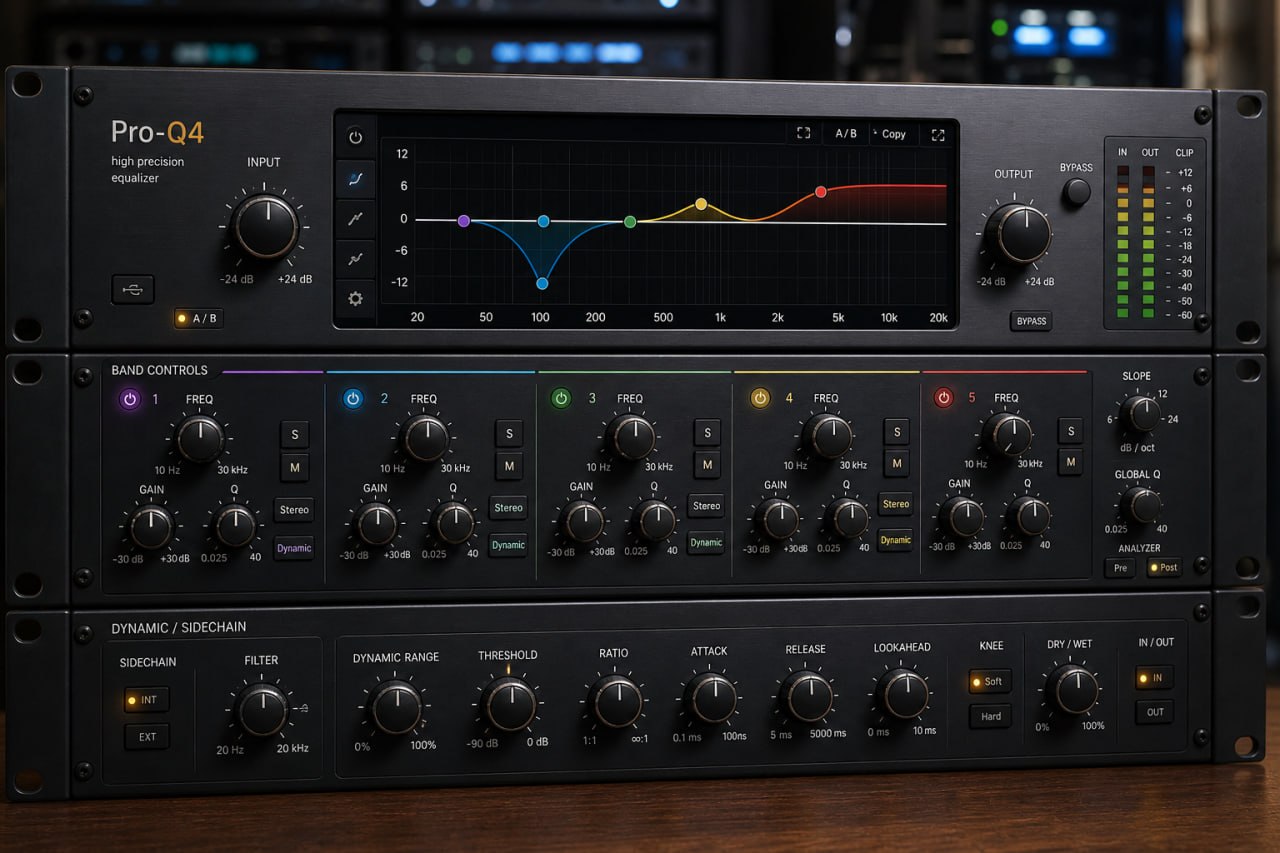
But when it comes to the digital domain, FabFilter-style node-based EQs win every time.
For example, in FabFilter Pro-Q, with one hand — or one cursor — you can simultaneously change frequency, gain, Q, add dynamic behavior, bypass a band, and so on.
It is faster, more precise, and fundamentally impossible to reproduce in the analog world at the same level of speed and accuracy.
So why keep redrawing analog knobs in plugins and copying the original control scheme exactly, when the way we interact with the tool is fundamentally different?
Would love to hear your thoughts on this.
P.S.
“Special shoutout” to manufacturers who draw concentric potentiometers in plugins — knobs with two axes, like on a Neve 1084. Absolutely love that💀💀
P.P.S.
I also have a theory that 90% of Inflator users only think they hear what it is doing, while actually being fooled by the loudness jump and its ridiculous bypass knob.
But that is a topic for another time.