Mastering Engineer’s Guide to Studio Monitors
 9 min read
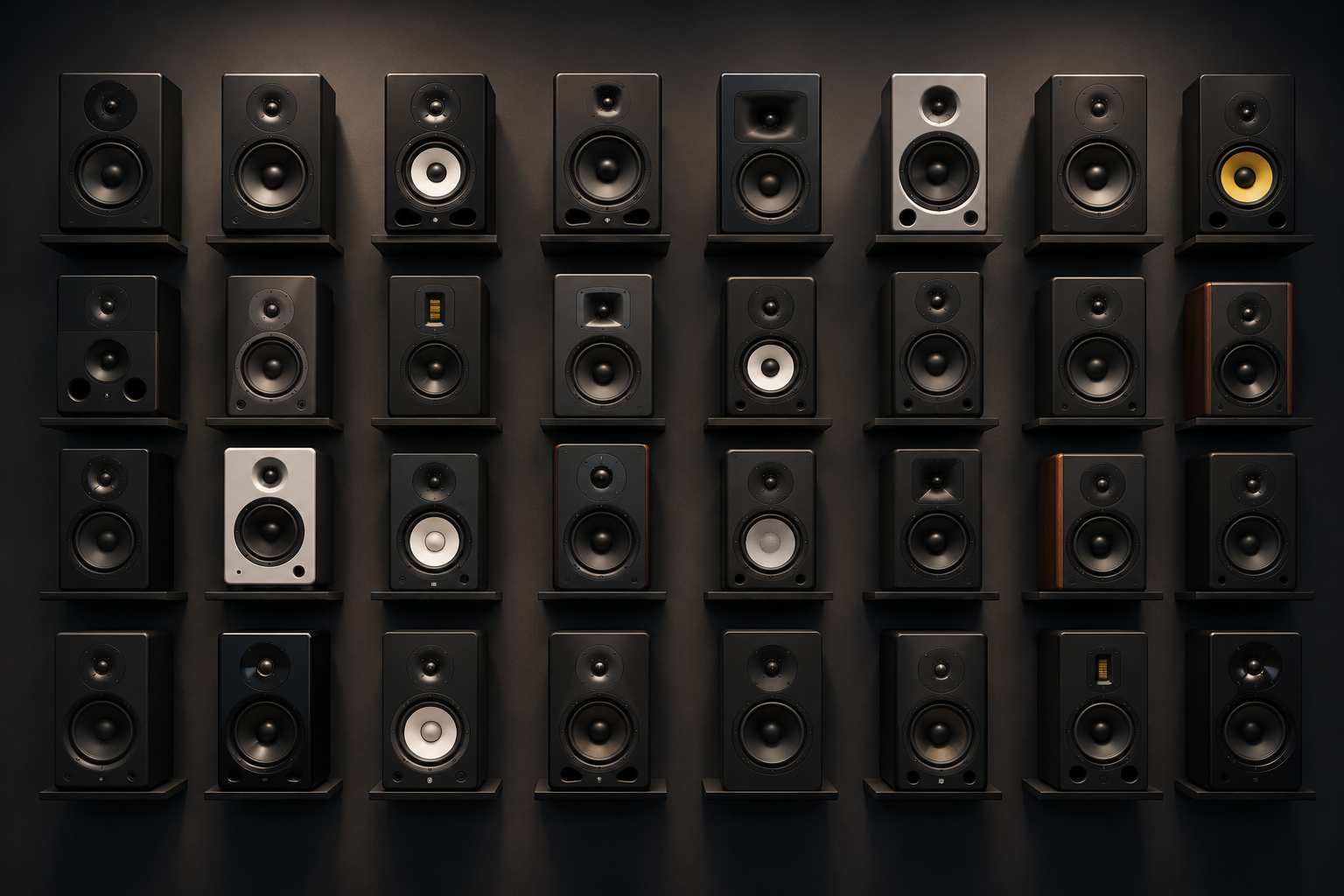
Let me start by saying that, to me, monitors are the most important part of any studio – second only to, or perhaps equally important as, the room acoustics.
Ever since I took my first steps in music, I have been fascinated by the search for the “perfect” playback system. I always wanted to find the most accurate and neutral reference possible, so that I could train my ears on something genuinely reliable from the very beginning.
During my first few years studying audio engineering, I went through nearly every used monitor listing I could find. A pair would stay in my room for a month or two before being sold and replaced by something else. That is how I managed to hear most of the mid-priced studio monitor market.
High-end speakers were more difficult to evaluate, because hearing a system briefly in somebody else’s studio does not really give you a complete understanding of it. To draw any meaningful conclusions, I believe you need to hear the same speakers in at least two or three different rooms.
That process gradually helped me develop my listening experience, and at the time I ultimately chose Amphion.
Over the years in the United States, I have also had the opportunity to hear many other remarkable systems that had previously been difficult for me to access. I have now formed an opinion on most of the major modern monitor designs, and I would like to share some of those thoughts.
Everything below is purely my personal opinion and is not intended to be treated as an objective or universal truth.
1. Amphion
The fastest speakers I have ever heard.
Even when placed next to Dutch & Dutch 8c monitors, they remain extremely impressive in terms of transient response.
I do have some questions about their frequency response. They are slightly more pronounced in the upper midrange and have a relatively soft top end. However, I became accustomed to that presentation, and I personally enjoy it.
Combined with stereo subwoofers, they become one of the best monitoring systems I have ever heard. I would be very interested to compare that setup directly with a full Kii tower system.
I have not properly worked on Amphion’s active models, apart from hearing them briefly at a trade show, and I have no particular desire to. To me, they clearly do not represent the company’s flagship offering.
2. Kii Audio THREE
Absolutely insane speakers – extremely accurate, extremely fast, and capable of producing a remarkably believable stereo image.
Their cardioid directivity is enormously helpful when dealing with room acoustics.
The standalone THREE monitors do not extend low enough to function as a truly full-range system. For that, you need the BXT bass modules.
This is currently my primary monitoring system. I upgraded to it after five years of working on Amphions, and the entire transition and adaptation process took approximately one day.
3. Dutch & Dutch 8c
Conceptually, these offer many of the same advantages as the Kii system, but cost approximately half as much when compared with the full Kii THREE BXT setup.
They also use cardioid directivity and are exceptionally good at separating a mix into distinct layers.
Despite their relatively compact size, they immediately create an impressive sense of scale, weight, and completeness. You understand what these speakers are capable of within the first ten seconds.
They also offer integration with Room EQ Wizard.
Compared with the Kii system, they are slightly slower and less precise. However, unlike the standalone Kii THREE, they do not require separate subwoofers.
4. ATC
The industry standard.
Clean, transparent, and physically enormous – at least when we are talking about full-range main monitoring systems.
They are an obvious go-to choice when the room is large enough and acoustically capable of supporting them.
For my taste, they are relatively slow compared with some of the other speakers on this list. I have been spoiled by the transient response of Amphion, PMC, and Kii systems.
ATCs also have a slightly distinctive midrange character, although it does not take long to get used to it.
The smaller SCM25s are excellent midfield monitors, but there is practically no real low-end extension.
5. PMC
Boosted bass, boosted highs, and recessed mids.
The larger and more expensive the model, the less obvious these characteristics become.
I find the twotwo series almost impossible to listen to – the top end simply burns my ears.
Their larger main monitors, such as the IB series and above, are genuinely impressive in terms of speed and detail.
Some models feel slightly more like producer-oriented speakers than strictly neutral engineering monitors. They can sound more aggressive and punchy than necessary, particularly the 8-2 series, although this is something you can adapt to.
In the context of large main monitors, I personally prefer them slightly to ATCs.
6. Genelec
The Ones series is impressive.
However, compared with the systems listed above, I personally feel that it loses in almost every category.
These are also DSP-based monitors, with the expected advantages of room correction, calibration, and system integration.
The rest of Genelec’s product range is generally solid and appropriately positioned for its price.
7. Neumann
The KH series may offer some of the most sensible and well-balanced monitors in their respective price categories.
Both the KH 120 and KH 310 are genuinely good speakers.
I have not properly tried the DSP-equipped versions, but I would expect them to perform even better once correctly calibrated.
8. Barefoot
Very producer-oriented speakers.
No matter how many times I have worked on them, I have never been able to interpret a mix properly.
They are also extremely dependent on the room.
The larger main systems can certainly move a lot of air. They are excellent when you want the control room to feel like a dance floor.
9. Focal
I have worked on Focals many times, and every experience left me frustrated.
To me, they sound highly distinctive, heavily colored, and particularly confusing through the midrange.
That applies both to their smaller models and their main monitoring systems.
They are simply not for me.
10. Quested
I have not heard every Quested model.
Older designs such as the VS2108 still sound surprisingly convincing, and they are very easy to adapt to.
I would really like to hear the company’s newer main monitoring systems.
11. Augspurger
Despite their prestigious status as go-to main monitors in many major studios, I have somehow never heard a pair that sounded genuinely excellent.
That probably has as much to do with the acoustics of the studios where they are installed as it does with the speakers themselves.
In many rooms, they are not really expected to sound “correct.” They function primarily as client speakers, with an enormous bass boost designed to excite both the room and the client.
12. ADAM Audio
The S Series consists of solid producer-oriented monitors.
Most of the company’s other models feel somewhat overrated within the low-to-mid-priced segment.
13. EVE Audio
More or less the same story as ADAM.
In nearly every room where I have heard them, there was an enormous low-frequency boost.
The bass itself also tended to sound boomy, slow, and poorly controlled.
I am not a fan.
14. Dynaudio
Essentially, these are dependable workhorses.
They are extremely common in post-production environments, including film mixing, Foley, and ADR studios.
Sound comes out of them, which is already something.
I have tried mixing on the BM15s – famously associated with Bob Clearmountain – and they are certainly usable. However, the aggressive and somewhat poisonous top end makes the process difficult for me.
15. Yamaha
The NS Series makes an excellent and attractive stand for placing other monitors on top of it. 🤌
The HS Series is an extremely popular option for affordable secondary monitoring. A used pair can be a perfectly reasonable choice for the money and is generally easy to resell.
Jokes aside, the NS Series consists of relatively fast, respectable old-school speakers.
Many engineers, including people such as Shawn Everett, have learned to produce extraordinary work on them.
However, compared with modern monitors, I do not believe they justify their current price. They are also difficult to work on unless you have spent a significant amount of time learning them.
16. ProAc Studio 100
Here I am referring to one specific model, largely because it is the monitor associated with Serban Ghenea.
They are solid, well-balanced speakers that are comfortable to work on.
However, in my opinion, they are slower and less precise than more modern designs from companies such as Amphion and Genelec.
17. IK Multimedia iLoud Micro Monitor
Unexpectedly, I am including these as well.
They may be the most convenient compact desktop monitors available.
They extend surprisingly low for their size while remaining relatively controlled and coherent.
They are obviously not a professional full-range reference system, but considering their dimensions and price, they are one of the most successful options in the category.
18. Exigy
These are serious speakers and sound remarkably similar to ATC’s square-format monitors.
Their midrange presentation is practically identical, presumably because they use similar drivers.
Overall, they are very comfortable to work on. However, like most speakers of this type, their performance depends more heavily on the room than on their published specifications.
19. Bowers & Wilkins
Again, serious and comfortable speakers.
However, they are extremely dependent on the room in which they are installed.
I have not heard enough of the smaller models to form a meaningful opinion.
20. Auratone, Avantone, Reftone, and Other Cubes
To me, checking a mix through a single small speaker is a somewhat outdated approach.
The consumer playback systems these speakers were originally intended to emulate – mono radios, mono televisions, portable cassette players, and similar devices – are no longer particularly relevant.
For the same reason, I would argue that the original practical purpose of the Yamaha NS-10 has also become less relevant.
For those who still enjoy this type of reference, passive Auratones provide the most iconic version of that sound.
Avantone and Reftone feel more like:
“We took your intentionally bad secondary reference and tried to turn it into a normal monitor. We are not entirely sure whether that made it better.”
Personally, I do not particularly like the Avantones.