Can You Really Mix in Headphones?
 3 min read
In my first studio, I had four monitor paths.
When I moved to the United States, for the first four months I had zero monitor paths and only one pair of headphones.
Did the quality of the work I produced during those months change?
Not that much.
A large part of that was thanks to what could be called developed listening experience.
The truth is that mixing in headphones is absolutely possible, as long as you understand their characteristics and how they differ from real studio monitors.
But to understand that, you first need to spend a certain amount of time working on good monitors in a properly treated room, while occasionally putting on headphones and comparing the results.
Our hearing is an adaptive tool, and it needs references. How can you tell whether you got the low end wrong in headphones when you do not know how the low end is supposed to sound in the first place?
Here is an analogy – imagine an artist with poor eyesight who spent their entire life painting without glasses. They could use the work of great masters as references and spend years learning to imitate them perfectly. But because they could not see all the details, even a technically accurate copy would still come out blurred.
Now imagine the same artist had used glasses for years but lost them right before an urgent job. Even in that situation, they could still produce a respectable result. They might not see every nuance clearly, but they would know exactly where to look for it and where to expect it – or how to avoid certain problems consciously.
Coming back to audio, this is why it is so important to train your ears on a reliable reference system from the beginning.
Technically, most high-quality modern headphones provide a fairly complete picture of the frequency spectrum, depth, stereo image, and dynamics.
The sub-bass can be handled with the help of an analyzer well enough for a mastering engineer to make the final adjustments later.
The main problems with working in headphones are mono compatibility, potential muddiness in the mix – because everything sounds so close to your ears that you may want to cut too much – the level of the center channel, and frequent mistakes in stereo width.
Anything in mono, such as the kick, snare, bass, and vocal, may end up either buried or, on the contrary, sticking out too much.
As a mastering engineer who regularly receives mixes made in headphones, these are the problems I correct most often.
If you pay attention to these nuances and learn how to check and correct yourself using analyzers, you can produce work at an extremely high level without turning on the monitors at all – although working this way is obviously very tiring for the ears.
For example, Andrew Scheps has spoken about mixing some of his projects entirely without monitors, simply because he was moving and did not have access to a proper monitoring system.
P.S.
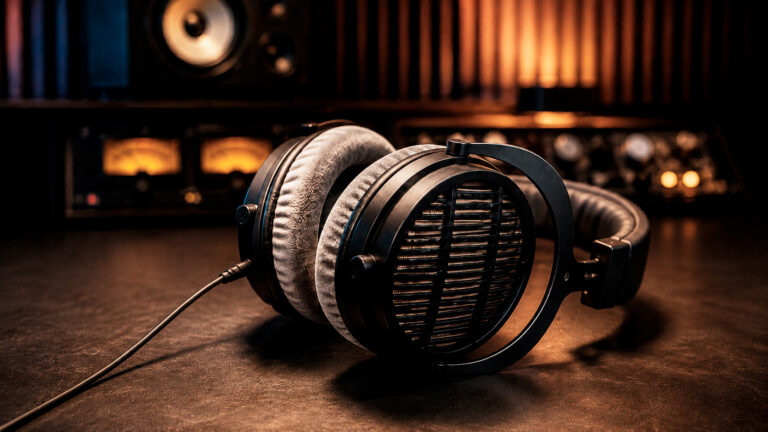
People often ask me to recommend good headphones for studio work. I use the Audeze LCD-5 and Sennheiser HD 800 S.
For more affordable options, the HD 600 and HD 650 are also quite good.
P.P.S.
“Should you use headphone correction software?” – I would not recommend it.
Without a proper understanding of acoustics and artificial spatial modeling, there is a high chance of making things worse rather than better.